輸入設備簡介
計算機通常使用三種輸入設備:鍵盤、鼠標和游戲桿。三種輸入設備都是其他設備所無法替代的,同時每種設備都各有優(yōu)缺點。鍵盤適用于輸入,但無法取代鼠標,而且和游戲桿相比,鍵盤也不如游戲桿那么靈巧。鼠標適用于定位和移動,但是和游戲桿相比,又缺少控制上的簡易性。至于游戲桿,它適用于簡單的移動----向上、向下、向左和向右移動,除此之外幾乎無任何用途。
通過鍵盤進行交互
基本上,鍵盤是按照一定邏輯格式排列的按鍵矩陣。除開一些微小差別之外,大多數(shù)鍵盤都有一種標準布局。鍵盤上的每個鍵實際上都是一個開關,當按下或者釋放一個鍵的時候,就觸發(fā)了這個開關。按下或者釋放一個鍵就向鍵盤的微處理器發(fā)送了一個信號,這樣就在計算機系統(tǒng)上產(chǎn)生了一個中段(interrupt)。系統(tǒng)從鍵盤的微處理器接收數(shù)據(jù),從而確定按下或者釋放了哪個鍵,接收的數(shù)據(jù)被稱為掃描碼(scan
code)。
中斷是各種各樣的信號,它通知系統(tǒng)一個設備或程序需要立即進行處理,使用中斷確保了系統(tǒng)知道設備的狀態(tài)已經(jīng)發(fā)生了改變。掃描碼是一些值,它們確定了鍵盤上的哪個鍵被按下或釋放了。這些掃描碼都是一個字節(jié)(操作系統(tǒng)可以使用很多方法來表示掃描碼),字節(jié)的一部分表示包含了哪個按鍵,一個位表示鍵是否被按下或釋放。掃描碼只能識別單個按鍵,無法區(qū)分大寫和小寫字母。因此,大寫字母A和小寫字母a擁有相同的掃描碼,通過跟蹤是否按住了Shift鍵,操作系統(tǒng)自動檢測和區(qū)分大小寫字母。
如下圖所示,這是一個典型的101-102鍵盤,鍵盤的局部放大圖顯示了一些帶有相應掃描碼的鍵,掃描碼是位編碼數(shù)字。
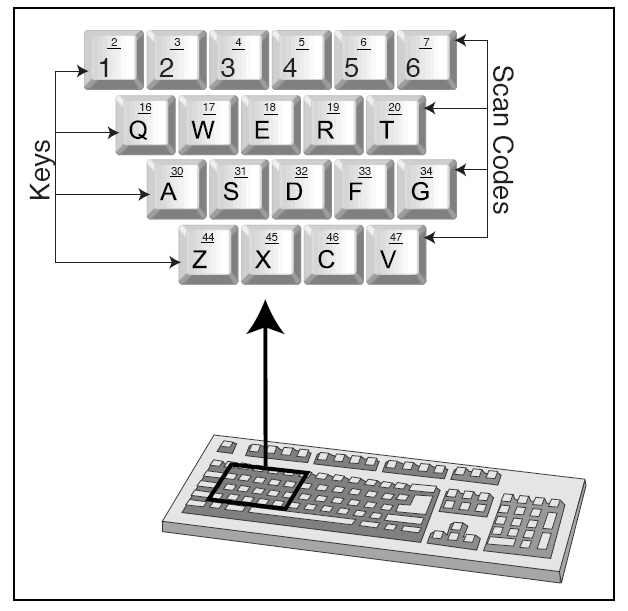
注意掃描碼是按照鍵盤上的順序進行排列的,每行中位于右邊的鍵通常是更高的掃描碼。掃描碼的最低7位(位0--6)表示了鍵值(被按下或者釋放的那個鍵),同時掃描碼的最高位(位7)表示此鍵是否被按下(該位被設置)或者釋放(該位被清除)。字節(jié)最高能夠表示的數(shù)字是255,且最高位保留,這樣就給出了128個鍵的空間。
在windows中處理鍵盤
windows能夠處理檢索鍵盤輸入的一般性任務,為了使工作變得更加容易,windows將從鍵盤接收到的掃描碼轉化成虛擬鍵碼以及ASCII碼的標準碼。windows采用許多方法將這些值報告給程序員,不過通常使用消息過程函數(shù)。
虛擬鍵碼是windows版本的掃描碼,舉例來說,字母A的掃描碼為30,但是虛擬鍵碼不使用這個值,而是使用虛擬鍵碼宏VK_A來表示字母A,不管使用什么樣的鍵盤(以及鍵盤報告的掃描碼),VK_A總是表示字母A。
ASCII(美國信息交換標準碼,American Standard Code for Information
Interchange)是一個標準,它規(guī)定了哪個值被映射到哪個字符。使用ASCII能夠為多達128個不同字符映射值,這些字符包括數(shù)字、字母表、一般符號以及控制碼。
windows實際使用的是擴展ASCII碼以及unicode字符(或寬字節(jié)字符)。擴展ASCII碼在規(guī)則ASCII上添加了信息的額外位,因此將字母的最大數(shù)目提升到了256。這樣做也帶來了不利的方面----擴展字符可以是任何東西,因為沒有實質(zhì)標準來約束這些字符。當然,因為有些其他語言需要更多的字符,因此Unicode就應運而生,它將字符的最大數(shù)目擴展到了16位,足夠存儲65536個字符。
使用DirectInput
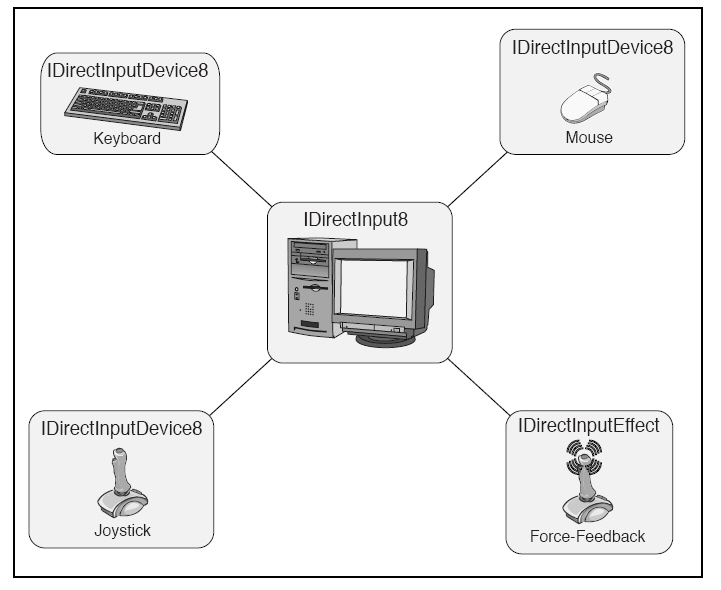
DirectInput是一些COM對象的集合(和所有DirectX組件相同),這些COM對象描繪了輸入系統(tǒng)和各個輸入設備。最主要的對象是DirectInput8,它用于初始化系統(tǒng)以及創(chuàng)建輸入設備接口。
DirectInput COM對象:
IDirectInput8:主要的DirectInput8 COM接口,其他所有接口都通過這個接口進行查詢。
DirectInputDevice8:用于輸入設備的COM接口,每個設備都有自己單獨的接口可供使用。
DirectInputEffect:用于力反饋效果的 COM接口,比如某些游戲桿和某些鼠標上的力反饋效果。
各種輸入設備(比如鍵盤、鼠標和游戲桿)都使用相同的接口對象IDirectInputDevice8。某些設備,比如游戲桿和鼠標,能夠通過查詢各自的
IDirectInputDevice8對象以得到另外一個接口IDirectInputEffect,這個接口用于控制設備的力反饋效果。
IDirectInput8、IDirectInputDevice8、IDirectInputEffect接口之間的關系如下圖所示:
IDirectInput8組件對象包含了很多用于初始化輸入系統(tǒng)以及獲得設備接口的函數(shù),在這些函數(shù)中,常用的只有兩個,它們是
IDirectInput8::EnumDevices和IDirectInput8::CreateDevice。
初始化DirectInput
要使用DirectInput,需要確保包含了DInput.h和在工程中鏈接了DInput8.lib,一個IDirectInput8對象就代表了主要DirectInput對象。
DirectInput提供了幫助函數(shù)DirectInput8Create用于初始化IDirectInput8接口。
Creates a DirectInput object and returns an IDirectInput8 Interface or later
interface.
HRESULT DirectInput8Create(
  HINSTANCE hinst,
  DWORD dwVersion,
  REFIID riidltf,
  LPVOID * ppvOut,
  LPUNKNOWN punkOuter
);
Parameters
- hinst
- Instance handle to the application or dynamic-link library (DLL) that is
creating the DirectInput object. DirectInput uses this value to determine
whether the application or DLL has been certified and to establish any
special behaviors that might be necessary for backward compatibility. It is
an error for a DLL to pass the handle to the parent application. For
example, an Microsoft ActiveX control embedded in a Web page that uses
DirectInput must pass its own instance handle, and not the handle to the
browser. This ensures that DirectInput recognizes the control and can enable
any special behaviors that might be necessary.
- dwVersion
- Version number of DirectInput for which the application is designed.
This value is normally DIRECTINPUT_VERSION. If the application defines
DIRECTINPUT_VERSION before including Dinput.h, the value must be greater
than 0x0800. For earlier versions, use DirectInputCreateEx, which is in
Dinput.lib.
- riidltf
- Unique identifier of the desired interface. This value is
IID_IDirectInput8A or IID_IDirectInput8W. Passing the IID_IDirectInput8
define selects the ANSI or Unicode version of the interface, depending on
whether UNICODE is defined during compilation.
- ppvOut
- Address of a pointer to a variable to receive the interface pointer if
the call succeeds.
- punkOuter
- Pointer to the address of the controlling object's IUnknown interface
for COM aggregation, or NULL if the interface is not aggregated. Most
calling applications pass NULL. If aggregation is requested, the object
returned in ppvOut is a pointer to IUnknown, as required by COM aggregation.
Return Values
If the function succeeds, the return value is DI_OK. If the function fails,
the return value can be one of the following error values:
DIERR_BETADIRECTINPUTVERSION, DIERR_INVALIDPARAM, DIERR_OLDDIRECTINPUTVERSION,
DIERR_OUTOFMEMORY.
Remarks
The DirectInput object created by this function is implemented in
Dinput8.dll. Versions of interfaces earlier than DirectX 8.0 cannot be obtained
in this implementation.
To create a DirectX 8.x interface with the latest DirectX SDK without using
CoCreateInstance:
- Set "#define DIRECTINPUT_VERSION 0x0800" before the include statement
for Dinput8.h.
- Call DirectInput8Create instead of DirectInputCreateEx.
- Link to the Dinput8.lib library instead of Dinput.lib.
To create a DirectX 8.x interface with the DirectX 8.x SDK without using
CoCreateInstance:
- Call DirectInput8Create instead of DirectInputCreateEx.
- Link to the Dinput8.lib library instead of Dinput.lib.
To create a DirectX 7.0 interface from the DirectX 8.x or latest DirectX SDK
without using CoCreateInstance:
- Set "#define DIRECTINPUT_VERSION 0x0700" before the include statement
for dinput.h.
- Call DirectInputCreateEx instead of DirectInput8Create.
- Link to the Dinput.lib library instead of Dinput8.lib.
To create a DirectX 7.0 interface from the DirectX 8.x or latest DirectX SDK
using CoCreateInstance:
- Call CoInitializeEx.
- Call CoCreateInstance using CLISID_DirectInput.
- Use IDirectInput7::Initialize to initialize the DirectInput object.
To create a DirectX 8.x or DirectX 9.0 interface from the DirectX 8.x or
latest DirectX SDK using CoCreateInstance:
- Call CoInitializeEx.
- Call CoCreateInstance using CLISID_DirectInput8.
- Use IDirectInput8::Initialize to initialize the DirectInput object.
Calling the function with pUnkOuter = NULL is equivalent to creating the
object through CoCreateInstance( &CLSID_DirectInput8, punkOuter,
CLSCTX_INPROC_SERVER, &IID_IDirectInput8W, lplpDirectInput), then initializing
it with IDirectInput8::Initialize.
Calling the function with pUnkOuter != NULL is equivalent to creating the
object through CoCreateInstance( &CLSID_DirectInput8, punkOuter,
CLSCTX_INPROC_SERVER, &IID_IUnknown, lplpDirectInput). The aggregated object
must be initialized manually.
使用DirectInput設備的步驟
1、獲取設備GUID,調(diào)用IDirectInput8::EnumDevice來實現(xiàn)。
2、創(chuàng)建設備COM對象,調(diào)用IDirectInput8::CreateDevice來實現(xiàn)。
3、設置數(shù)據(jù)格式,調(diào)用IDirectInputDevice8::SetDataFormat來實現(xiàn)。
4、設置協(xié)作級別,調(diào)用IDirectInputDevice8::SetCooperativeLevel來實現(xiàn)。
5、設置任何特殊屬性,調(diào)用IDirectInputDevice8::SetProperty來實現(xiàn)。
6、獲得設備,調(diào)用IDirectInputDevice8::Acquire來實現(xiàn)。
7、輪詢設備,調(diào)用IDirectInputDevice8::Poll來實現(xiàn)。
8、讀取數(shù)據(jù),調(diào)用IDirectInputDevice8::GetDeviceState來實現(xiàn)。
在進行這些步驟前,要確保聲明了一個IDirectInput設備對象,即IDirectInputDevice8對象。
獲取設備GUID
每個安裝的設備都有一個系統(tǒng)分配的全局惟一標識符(global unique identification, GUID)數(shù)字。要使用一個設備,首先必須知道它的GUID。對于連接到系統(tǒng)上的鼠標和鍵盤,得到他們的GUID非常容易,DirectInput分別為鼠標和鍵盤的GUID定義成GUID_SysKeyboard和GUID_SysMouse。要使用GUID_SysKeyboard或
GUID_SysMouse,必須在所有其他的預處理程序指令前定義INITGUID,或者將DXGuid.lib庫鏈接到項目中。至于其他設備,必須枚舉出這些設備,才能得到需要的那些設備的GUID。枚舉就是遍歷一個含有數(shù)據(jù)項的列表的過程,數(shù)據(jù)項就是諸如游戲桿之類的輸入設備。假設有5個游戲桿連接到了系統(tǒng)上,那么在枚舉的過程中,DirectInput就會傳遞各個游戲桿的相關信息,而且每次只傳遞一個游戲桿的信息,直到所有的游戲桿都已經(jīng)被列出來或者列舉被強行終止。
用于枚舉設備的函數(shù)是IDirectInput8::EnumDevice。
Enumerates available devices.
HRESULT EnumDevices(
  DWORD dwDevType,
  LPDIENUMDEVICESCALLBACK lpCallback,
  LPVOID pvRef,
  DWORD dwFlags
);
Parameters
- dwDevType
Device type filter.
- To restrict the enumeration to a particular type of device, set this
parameter to a DI8DEVTYPE_* value. See DIDEVICEINSTANCE.
To enumerate a class of devices, use one of the following values.
- DI8DEVCLASS_ALL
- All devices.
- DI8DEVCLASS_DEVICE
- All devices that do not fall into another class.
- DI8DEVCLASS_GAMECTRL
- All game controllers.
- DI8DEVCLASS_KEYBOARD
- All keyboards. Equivalent to DI8DEVTYPE_KEYBOARD.
- DI8DEVCLASS_POINTER
- All devices of type DI8DEVTYPE_MOUSE and DI8DEVTYPE_SCREENPOINTER.
- lpCallback
- Address of a callback function to be called once for each device
enumerated. See DIEnumDevicesCallback.
- pvRef
- Application-defined 32-bit value to be passed to the enumeration
callback each time it is called.
- dwFlags
- Flag value that specifies the scope of the enumeration. This parameter
can be one or more of the following values:
- DIEDFL_ALLDEVICES
- All installed devices are enumerated. This is the default behavior.
- DIEDFL_ATTACHEDONLY
- Only attached and installed devices.
- DIEDFL_FORCEFEEDBACK
- Only devices that support force feedback.
- DIEDFL_INCLUDEALIASES
- Include devices that are aliases for other devices.
- DIEDFL_INCLUDEHIDDEN
- Include hidden devices. For more information about hidden devices,
see DIDEVCAPS.
- DIEDFL_INCLUDEPHANTOMS
- Include phantom (placeholder) devices.
Return Values
If the method succeeds, the return value is DI_OK. If the method fails, the
return value can be one of the following error values: DIERR_INVALIDPARAM,
DIERR_NOTINITIALIZED.
Remarks
All installed devices can be enumerated, even if they are not present. For
example, a flight stick might be installed on the system but not currently
plugged into the computer. Set the dwFlags parameter to indicate whether only
attached or all installed devices should be enumerated. If the
DIEDFL_ATTACHEDONLY flag is not present, all installed devices are enumerated.
A preferred device type can be passed as a dwDevType filter so that only the
devices of that type are enumerated.
On Microsoft Windows XP, DirectInput enumerates only one mouse and one
keyboard device, referred to as the system mouse and the system keyboard. These
devices represent the combined output of all mice and keyboards respectively on
a system. For information about how to read from multiple mice or keyboards
individually on Windows XP, see the WM_INPUT documentation.
Note The order in which devices are enumerated
by DirectInput is not guaranteed.
lpCallback是一個指向枚舉函數(shù)的指針,在系統(tǒng)上每找到一個匹配的設備時,就會調(diào)用該函數(shù)。
Application-defined callback function that receives DirectInput devices as a
result of a call to the IDirectInput8::EnumDevices method.
BOOL DIEnumDevicesCallback(
  LPCDIDEVICEINSTANCE lpddi,
  LPVOID pvRef
);
Parameters
- lpddi
- Address of a DIDEVICEINSTANCE structure that describes the device
instance.
- pvRef
- The application-defined value passed to IDirectInput8::EnumDevices
or IDirectInput8::EnumDevicesBySemantics as the pvRef parameter.
Return Values
Returns DIENUM_CONTINUE to continue the enumeration or DIENUM_STOP to stop
the enumeration.
Remarks
If a single hardware device can function as more than one DirectInput device
type, it is enumerated as each device type that it supports. For example, a
keyboard with a built-in mouse is enumerated twice: once as a keyboard and once
as a mouse. The product globally unique identifier (GUID) is the same for each
device, however.
lpddi是一個指向DIDEVICEINSTANCE結構體的指針,此結構體包含了此次調(diào)用時當前枚舉設備上的信息。
Describes an instance of a DirectInput device. This structure is used with
the IDirectInput8::EnumDevices, IDirectInput8::EnumDevicesBySemantics, and
IDirectInputDevice8::GetDeviceInfo methods.
typedef struct DIDEVICEINSTANCE {
    DWORD dwSize;
    GUID guidInstance;
    GUID guidProduct;
    DWORD dwDevType;
    TCHAR tszInstanceName[MAX_PATH];
    TCHAR tszProductName[MAX_PATH];
    GUID guidFFDriver;
    WORD wUsagePage;
    WORD wUsage;
} DIDEVICEINSTANCE, *LPDIDEVICEINSTANCE;
Members
- dwSize
- Size of this structure, in bytes. This member must be initialized before
the structure is used.
- guidInstance
- Unique identifier for the instance of the device. An application can
save the instance globally unique identifier (GUID) into a configuration
file and use it at a later time. Instance GUIDs are specific to a particular
computer. An instance GUID obtained from one computer is unrelated to
instance GUIDs on another.
- guidProduct
- Unique identifier for the product. This identifier is established by the
manufacturer of the device.
- dwDevType
- Device type specifier. The least-significant byte of the device type
description code specifies the device type. The next-significant byte
specifies the device subtype. This value can also be combined with
DIDEVTYPE_HID, which specifies a Human Interface Device (human interface
device).
- tszInstanceName
- Friendly name for the instance. For example, "Joystick 1."
- tszProductName
- Friendly name for the product.
- guidFFDriver
- Unique identifier for the driver being used for force feedback. The
driver's manufacturer establishes this identifier.
- wUsagePage
- If the device is a Human Interface Device (HID), this member contains
the HID usage page code.
- wUsage
- If the device is a Human Interface Device (HID), this member contains
the HID usage code.
Remarks
The following device types and subtypes are defined for use in the dwDevType
member.
- DI8DEVTYPE_1STPERSON
First-person action game device. The following subtypes are defined.
- DI8DEVTYPE1STPERSON_LIMITED
Device that does not provide the minimum number of device objects for
action mapping.
- DI8DEVTYPE1STPERSON_SHOOTER
Device designed for first-person shooter games.
- DI8DEVTYPE1STPERSON_SIXDOF
Device with six degrees of freedom; that is, three lateral axes and
three rotational axes.
- DI8DEVTYPE1STPERSON_UNKNOWN
Unknown subtype.
- DI8DEVTYPE_DEVICE
Device that does not fall into another category.
- DI8DEVTYPE_DEVICECTRL
Input device used to control another type of device from within the
context of the application. The following subtypes are defined.
- DI8DEVTYPE_DRIVING
Device for steering. The following subtypes are defined.
- DI8DEVTYPEDRIVING_COMBINEDPEDALS
Steering device that reports acceleration and brake pedal values from
a single axis.
- DI8DEVTYPEDRIVING_DUALPEDALS
Steering device that reports acceleration and brake pedal values from
separate axes.
- DI8DEVTYPEDRIVING_HANDHELD
Hand-held steering device.
- DI8DEVTYPEDRIVING_LIMITED
Steering device that does not provide the minimum number of device
objects for action mapping.
- DI8DEVTYPEDRIVING_THREEPEDALS
Steering device that reports acceleration, brake, and clutch pedal
values from separate axes.
- DI8DEVTYPE_FLIGHT
Controller for flight simulation. The following subtypes are defined.
- DI8DEVTYPE_GAMEPAD
Gamepad. The following subtypes are defined.
- DI8DEVTYPEGAMEPAD_LIMITED
Gamepad that does not provide the minimum number of device objects
for action mapping.
- DI8DEVTYPEGAMEPAD_STANDARD
Standard gamepad that provides the minimum number of device objects
for action mapping.
- DI8DEVTYPEGAMEPAD_TILT
Gamepad that can report x-axis and y-axis data based on the attitude
of the controller.
- DI8DEVTYPE_JOYSTICK
Joystick. The following subtypes are defined.
- DI8DEVTYPE_KEYBOARD
Keyboard or keyboard-like device. The following subtypes are defined.
- DI8DEVTYPEKEYBOARD_UNKNOWN
Subtype could not be determined.
- DI8DEVTYPEKEYBOARD_PCXT
IBM PC/XT 83-key keyboard.
- DI8DEVTYPEKEYBOARD_OLIVETTI
Olivetti 102-key keyboard.
- DI8DEVTYPEKEYBOARD_PCAT
IBM PC/AT 84-key keyboard.
- DI8DEVTYPEKEYBOARD_PCENH
IBM PC Enhanced 101/102-key or Microsoft Natural keyboard.
- DI8DEVTYPEKEYBOARD_NOKIA1050
Nokia 1050 keyboard.
- DI8DEVTYPEKEYBOARD_NOKIA9140
Nokia 9140 keyboard.
- DI8DEVTYPEKEYBOARD_NEC98
Japanese NEC PC98 keyboard.
- DI8DEVTYPEKEYBOARD_NEC98LAPTOP
Japanese NEC PC98 laptop keyboard.
- DI8DEVTYPEKEYBOARD_NEC98106
Japanese NEC PC98 106-key keyboard.
- DI8DEVTYPEKEYBOARD_JAPAN106
Japanese 106-key keyboard.
- DI8DEVTYPEKEYBOARD_JAPANAX
Japanese AX keyboard.
- DI8DEVTYPEKEYBOARD_J3100
Japanese J3100 keyboard.
- DI8DEVTYPE_MOUSE
A mouse or mouse-like device (such as a trackball). The following
subtypes are defined.
- DI8DEVTYPE_REMOTE
Remote-control device. The following subtype is defined.
- DI8DEVTYPE_SCREENPOINTER
Screen pointer. The following subtypes are defined.
- DI8DEVTYPESCREENPTR_UNKNOWN
Unknown subtype.
- DI8DEVTYPESCREENPTR_LIGHTGUN
Light gun.
- DI8DEVTYPESCREENPTR_LIGHTPEN
Light pen.
- DI8DEVTYPESCREENPTR_TOUCH
Touch screen.
- DI8DEVTYPE_SUPPLEMENTAL
Specialized device with functionality unsuitable for the main control of
an application, such as pedals used with a wheel. The following subtypes are
defined.
- DI8DEVTYPESUPPLEMENTAL_2NDHANDCONTROLLER
Secondary handheld controller.
- DI8DEVTYPESUPPLEMENTAL_COMBINEDPEDALS
Device whose primary function is to report acceleration and brake
pedal values from a single axis.
- DI8DEVTYPESUPPLEMENTAL_DUALPEDALS
Device whose primary function is to report acceleration and brake
pedal values from separate axes.
- DI8DEVTYPESUPPLEMENTAL_HANDTRACKER
Device that tracks hand movement.
- DI8DEVTYPESUPPLEMENTAL_HEADTRACKER
Device that tracks head movement.
- DI8DEVTYPESUPPLEMENTAL_RUDDERPEDALS
Device with rudder pedals.
- DI8DEVTYPESUPPLEMENTAL_SHIFTER
Device that reports gear selection from an axis.
- DI8DEVTYPESUPPLEMENTAL_SHIFTSTICKGATE
Device that reports gear selection from button states.
- DI8DEVTYPESUPPLEMENTAL_SPLITTHROTTLE
Device whose primary function is to report at least two throttle
values. It may have other controls.
- DI8DEVTYPESUPPLEMENTAL_THREEPEDALS
Device whose primary function is to report acceleration, brake, and
clutch pedal values from separate axes.
- DI8DEVTYPESUPPLEMENTAL_THROTTLE
Device whose primary function is to report a single throttle value.
It may have other controls.
- DI8DEVTYPESUPPLEMENTAL_UNKNOWN
Unknown subtype.
Versions of DirectInput earlier than DirectX 8.0 have a somewhat different
scheme of device types and subtypes. See the DIDEVTYPExxx defines in Dinput.h.
創(chuàng)建設備COM對象
有了設備GUID,就能創(chuàng)建實際的IDirectInputDevice8
COM對象了,用于創(chuàng)建此COM對象的函數(shù)是IDirectInput8::CreateDevice。
Creates and initializes an instance of a device based on a given globally
unique identifier (GUID), and obtains an IDirectInputDevice8 Interface
interface.
HRESULT CreateDevice(
  REFGUID rguid,
  LPDIRECTINPUTDEVICE * lplpDirectInputDevice,
  LPUNKNOWN pUnkOuter
);
Parameters
- rguid
- Reference to the GUID for the desired input device (see Remarks). The
GUID is retrieved through the IDirectInput8::EnumDevices method, or it can
be one of the predefined GUIDs listed below. For the following GUID values
to be valid, your application must define INITGUID before all other
preprocessor directives at the beginning of the source file, or link to
Dxguid.lib.
- GUID_SysKeyboard
- The default system keyboard.
- GUID_SysMouse
- The default system mouse.
- lplpDirectInputDevice
- Address of a variable to receive the IDirectInputDevice8 Interface
interface pointer if successful.
- pUnkOuter
- Address of the controlling object's IUnknown interface for COM
aggregation, or NULL if the interface is not aggregated. Most calling
applications pass NULL.
Return Values
If the method succeeds, the return value is DI_OK. If the method fails, the
return value can be one of the following: DIERR_DEVICENOTREG, DIERR_INVALIDPARAM,
DIERR_NOINTERFACE, DIERR_NOTINITIALIZED, DIERR_OUTOFMEMORY.
Remarks
Calling this method with pUnkOuter = NULL is equivalent to creating the
object by CoCreateInstance (&CLSID_DirectInputDevice, NULL, CLSCTX_INPROC_SERVER,
riid, lplpDirectInputDevice) and then initializing it with Initialize.
Calling this method with pUnkOuter != NULL is equivalent to creating the
object by CoCreateInstance (&CLSID_DirectInputDevice, punkOuter,
CLSCTX_INPROC_SERVER, &IID_IUnknown, lplpDirectInputDevice). The aggregated
object must be initialized manually.
閱讀下篇:
使用DirectInput進行交互(2)